Every full-size American pickup truck leaves the factory sitting lower in the front than the rear. That height difference - known as factory rake - is not an oversight. Manufacturers design suspension geometry to handle payload and trailer tongue weight. When a truck is loaded with 1,500 pounds in the bed or pulling a heavy trailer, the rear suspension compresses and the nose rises slightly. The rake ensures the truck runs roughly level under working load, which is what the chassis, steering, and driveline were engineered around.
When the truck runs empty, though, the front end sits noticeably lower than the rear. On most F-150s the rake is 1.5 to 2.5 inches. Silverado and Sierra 1500s typically have around 1.5 to 2 inches. Ram 1500s have the least rake of the three, often around 1 to 1.5 inches. That nose-down angle affects appearance, limits how large a front tire you can fit without rubbing, and is the problem a leveling kit is designed to solve.
A leveling kit raises the front of the truck to match - or nearly match - the rear height. Done right, it creates a level stance, opens up front wheel-well clearance for modestly larger tires, and costs considerably less than a full suspension lift. What a leveling kit does not do is raise the rear of the truck or dramatically increase overall ground clearance. If those are the goals, a full lift kit is the appropriate tool, and the distinction between the two will come up again toward the end of this guide.
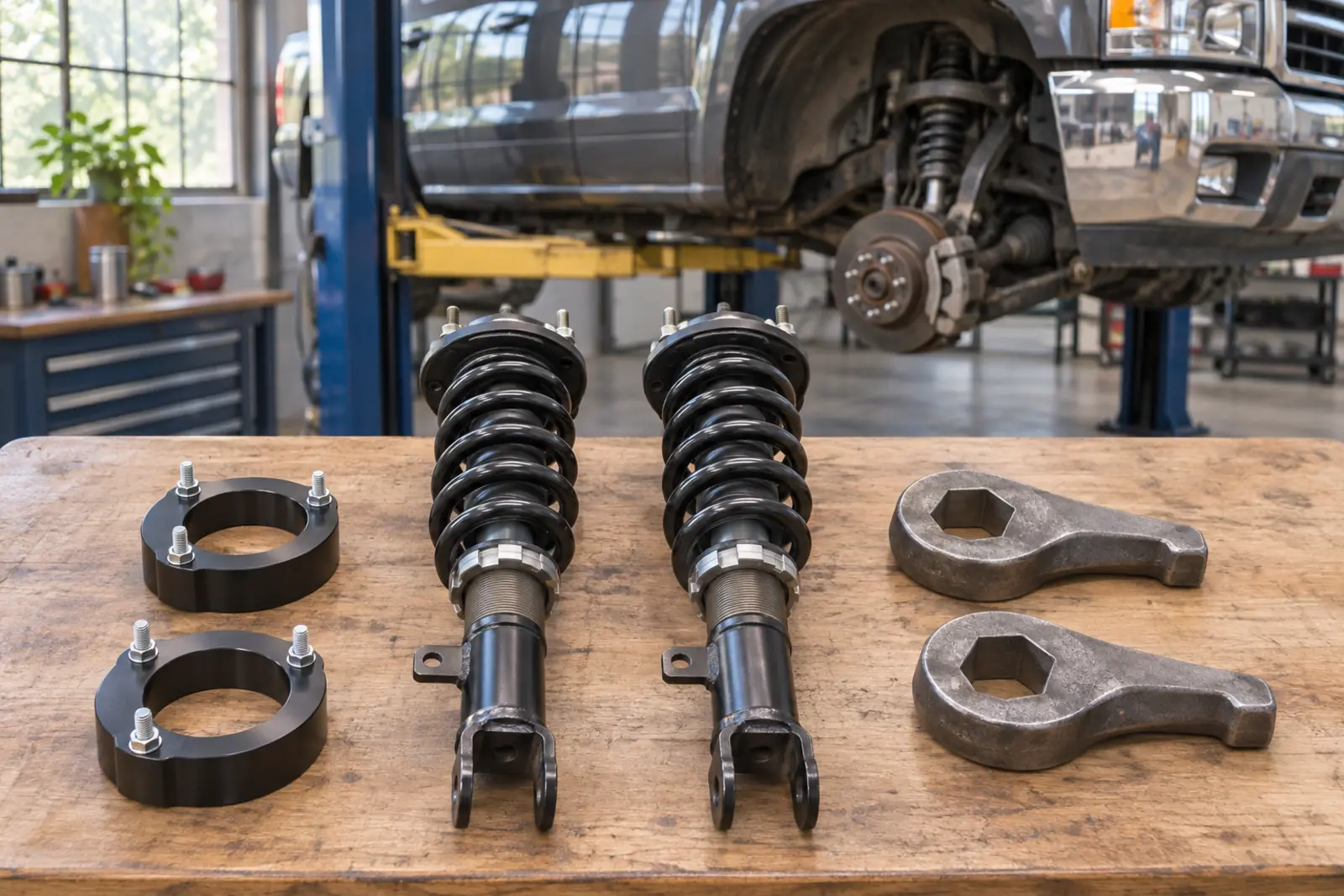
There are three distinct types of leveling kits on the market, and they are not interchangeable. Each type works with a specific suspension architecture. Installing the wrong type is not a mistake you can make easily - the hardware will not fit - but choosing between them still requires understanding what is under the front of your truck.
Spacer Leveling Kits: The Most Common Type
Spacer leveling kits are the standard solution for any modern pickup truck with strut-type front suspension. That includes all F-150s from 2004 onward, Silverado and Sierra 1500s from the 2007 model year onward, and Ram 1500s across all recent generations. If you own one of these trucks in a 4WD or AWD configuration, a spacer kit is almost certainly the right choice.
The design is simple. A machined spacer - made from billet aluminum or high-density polyurethane - sits on top of the front strut mount, between the top of the strut assembly and the vehicle's frame tower. This positions the entire strut lower relative to the frame, which raises the wheel relative to the body. The spacer does not alter the spring, the shock, or the suspension travel. It adds height above the existing assembly and nothing else.
Billet aluminum spacers are more common and generally preferred. They are dimensionally stable, do not compress or creep over time, and machine to tight tolerances. Polyurethane spacers are lighter and cheaper but can compress slightly under load, which means the installed height may be a fraction less than advertised on heavily loaded trucks. For most daily drivers the difference is inconsequential, but billet is the default recommendation from most experienced installers.
Popular spacer leveling kit brands include ReadyLIFT, Rough Country, Daystar, Zone Offroad, SuperLift, and several others. ReadyLIFT and Zone tend to represent a middle tier of quality and price. Daystar's polyurethane kits are lightweight entry-level options. SuperLift and Fabtech target more demanding use cases. Pricing for a quality billet aluminum spacer kit for a popular truck runs approximately $80 to $200 for the pair, not including labor or the required alignment.
The appeal of spacer kits is that installation is straightforward. The truck is lifted, the wheel comes off, and the top of the strut tower is accessed from the engine bay. The factory strut nut is removed, the spacer goes in, and the nut goes back on. The job is DIY-accessible for someone with a floor jack, jack stands, basic hand tools, and a torque wrench - most experienced home mechanics can complete the front end in under two hours. The rear of the truck is not touched.
One important caveat applies at higher spacer heights. At 2.5 inches and above, the CV axle angle steepens enough that it can accelerate wear on the outer CV joint, the boot, and the front axle shaft. Most kit manufacturers and installers recommend adding extended upper control arms (UCAs) when going beyond 2 inches on many truck applications. UCAs with an alignment-correcting design restore proper caster angle and keep the CV axle operating within its intended range. This adds cost - quality UCA kits run $300 to $700 or more - but it is the right approach if 2.5 inches or more is the target.
One more timing consideration: a spacer kit does not replace or improve the factory shock. If the factory strut is worn, the spacer will not fix the resulting poor ride quality, and in some cases the new geometry at the strut mount makes worn dampers more noticeable. Many owners choose to replace the front shocks at the same time as the leveling kit installation. The shock absorber buying guide for F-150, Silverado, and Ram covers which aftermarket dampers deliver the most improvement for different budgets and use cases.
Torsion Key Leveling Kits: Older GM Trucks Explained
A significant slice of Chevy and GMC trucks use a completely different front suspension architecture: torsion bars. Instead of a coil spring, a torsion bar - a long steel rod that twists under load to absorb road input - runs lengthwise along the frame. The front of the bar attaches to the lower control arm. The rear of the bar fits into a torsion key, which locks into a cross-member-mounted bracket. The key determines how much preload is on the bar at ride height, and the bracket has an adjustment bolt that can increase or decrease that preload.
The factory torsion bar setting is intentionally conservative. GM sets the front end low enough to maintain rake, to keep ball joints and CV axles in a comfortable operating range, and to leave room in the suspension travel for load. The factory key positions the bar at a point well within its travel range - there is room to raise the front end without damage, up to a point.
Two approaches exist for leveling a torsion bar truck:
The first is simply cranking the factory adjustment bolt. Turning it clockwise increases preload on the torsion bar, which raises the front end. This costs nothing and can be done with basic tools. The problem is that beyond a modest amount of rotation, the torsion bar operates near the limit of its comfortable travel. Ride quality degrades as effective spring rate increases. The bar can develop a permanent set over time. Ball joints and CV axle joints may wear faster because the geometry is now outside the designed operating range. An alignment is still required after any adjustment.
The second approach - and the right one for any meaningful lift - is a replacement torsion key kit. Aftermarket torsion keys are machined with an offset relative to the factory key. The offset allows the front end to sit at a raised height while keeping the torsion bar in a more relaxed position within its travel range. The result is the same front lift with significantly less stress on the bar and better operating geometry for the ball joints. Quality torsion key kits from BDS, ReadyLIFT, or SuperLift typically include the keys, the required hardware, and instructions for getting the ride height set correctly. Many also include front shock extensions to match the rear height if needed.
After any torsion key replacement or crank adjustment, a professional alignment is not optional - it is required immediately. The caster and camber angles change with the front height, and driving on badly misaligned geometry will ruin tires and stress steering components.
The trucks that require torsion key kits:
- 1988-1998 Chevy and GMC K-series 4WD (GMT400 platform) - 1500, 2500, and 3500
- 1999-2006 Silverado and Sierra 1500 4WD (GMT800 platform)
- 1999-2006 Silverado and Sierra 2500 and 3500 4WD (GMT800 platform)
- 2007-2010 Silverado and Sierra 2500HD and 3500HD 4WD (GMT900 HD)
The 2007-and-newer Silverado and Sierra 1500 trucks (GMT900, K2, and T1XX platforms) switched to coil spring strut front suspension. If you own a half-ton Silverado or Sierra with a 2007 or later model year, it uses struts and needs a spacer leveling kit - not a torsion key kit.
Coilover Leveling Kits: When the Upgrade Makes Sense
A coilover combines the coil spring and shock absorber into a single unified assembly. Leveling coilovers replace the factory strut entirely and add a threaded collar that allows precise ride height adjustment. Depending on the product and application, that adjustment range typically spans 0.5 to 3.5 inches of lift.
The key distinction from a spacer kit is what happens to the damper. A spacer kit leaves the factory shock doing all the same work it was doing before. A coilover replaces the factory damper with something better. Entry-level leveling coilovers from brands like Fox, King, or Bilstein use monotube gas-charged dampers that offer more controlled compression and rebound than a worn or base-spec factory strut. High-end coilover assemblies add remote reservoirs, independent compression and rebound adjustment, and increased suspension travel for off-road use.
One product category worth calling out specifically sits between a pure coilover and a spacer kit: the performance adjustable shock. The Bilstein 5100 series monotube shock is the most widely known example. The 5100 is a performance replacement shock rather than a true coilover, but many versions include a threaded ride-height adjuster built into the lower mounting collar, offering three height positions - typically 0 inches, 0.85 inches, and 2.5 inches of lift depending on how the lower mount is set. This makes the 5100 a popular choice for owners who want meaningfully better damping and modest leveling without paying full coilover prices. Fox Performance Series shocks offer a similar concept. Installing these in place of worn factory struts often improves ride quality noticeably while also achieving a leveled stance.
True leveling coilovers with full spring replacement and full height adjustability run $500 to $1,500 or more for a matched front pair. That price point is hard to justify for a street-only daily driver that simply wants a level stance and 33-inch tires. For those applications, a quality spacer kit at $100 to $200 and a simultaneous shock upgrade at $150 to $400 achieves a comparable visual result for less money.
Coilover leveling kits earn their cost in specific situations:
- Trucks used for off-roading or overlanding, where improved suspension articulation and damper durability over rough terrain are worth the investment
- Owners who tow or haul frequently and find stock dampers wallow or bottom out under load
- Anyone replacing worn factory shocks anyway - the incremental cost of going to a performance coilover is smaller when new dampers are already in the budget
- Trucks that see gravel roads, forest service roads, or trail driving, where better damping makes a real difference in control and comfort
What Size Leveling Kit Do You Need: 1-Inch vs 2-Inch vs 2.5-Inch
Choosing the right height matters as much as choosing the right type. The correct size depends on three factors: how much factory rake the truck has, what tire size you want to run, and whether you are willing to also install upper control arms alongside the leveling kit.
1-inch leveling kits produce a barely visible change in stance. They are appropriate for trucks with less factory rake - Ram 1500 models, with their modest nose-down angle, can be leveled reasonably well with 1 inch on some configurations. For F-150 and Silverado owners, 1 inch typically leaves the front still noticeably lower than the rear. The practical use case for 1 inch is primarily clearing a slightly taller wheel-and-tire combination without changing the truck's visual character. Alignment impact is minimal. UCAs are never required at 1 inch.
1.5-inch leveling kits represent the sweet spot for many Ram 1500 trucks. The Ram's lower factory rake means 1.5 inches brings the front close to level with the rear. For F-150 and Silverado owners with more rake to correct, 1.5 inches often leaves the front still slightly lower than the rear. At this height, alignment changes are modest and no additional suspension components are required.
2-inch leveling kits are the most popular choice across all three truck brands, and for good reason. Two inches of front lift levels most F-150 and Silverado models to within a fraction of an inch of the rear height, and brings the Ram 1500 to a slightly nose-high appearance that many owners prefer over perfectly level. At 2 inches, most trucks can fit 33-inch tires on stock wheels without rubbing. Upper control arms are not required on the majority of applications at this height, though they are still recommended for trucks that see heavy off-road use or will accumulate high mileage. The required alignment adjustment is achievable at any shop with a standard alignment rack. If there is a default recommendation for the typical owner, 2 inches is it.
2.5-inch leveling kits push into territory where suspension geometry demands more attention. At 2.5 inches, the CV axle operates at a steeper angle, and the caster change is significant enough that some trucks cannot achieve ideal alignment specs without a cam bolt kit or - better - extended upper control arms. Most manufacturers and experienced installers recommend UCAs at 2.5 inches on F-150 and Silverado applications. Without them, CV axle wear accelerates, especially on trucks that encounter rough surfaces or accumulate significant mileage. At 2.5 inches, most trucks can fit 33 to 34-inch tires; fitting 35s typically requires additional fender trimming or flares.
3-inch leveling kits are marketed by several brands but are really at the edge of what a "leveling kit" designation covers. At 3 inches, UCAs are essentially mandatory, caster correction is a priority, and the rear of the truck may visually appear lower than the front at stock height unless a small rear spacer or add-a-leaf is used. Many owners who want 3 inches of front lift choose a full 4-inch suspension lift kit instead, since the cost difference - once UCAs are factored in - is not dramatically different, and the full lift offers better articulation and more complete component engineering. The leveling kit buying guide breaks down specific product choices by truck model, year, and desired height with more detail on what each size actually requires.
Which Type Fits Your F-150, Silverado, and Ram
Ford F-150
All F-150 trucks from the 2004 model year onward use independent front suspension with struts. This includes every generation through the 2024 model year. Spacer leveling kits are the correct type for all of these trucks, with the 2-inch size being the most popular choice. For owners who want improved damping alongside leveling, the Bilstein 5100 series or comparable adjustable monotube shocks are worth considering over a basic spacer kit - especially on higher-mileage trucks where the factory struts are due for replacement regardless.
At 2.5 inches or more on the 2015-and-newer aluminum-body F-150, upper control arms are recommended. The aluminum-body trucks have tighter engineering tolerances than the steel-body predecessors, and the CV axle geometry at 2.5 inches warrants the correction that UCAs provide. The 2004-2014 steel-body F-150 is somewhat more forgiving but still benefits from UCAs at 2.5 inches.
Chevy Silverado and GMC Sierra 1500 (2007-Present)
The GMT900 (2007-2013), K2 (2014-2018), and T1XX (2019-present) Silverado and Sierra 1500 all use coil spring strut front suspension. Spacer leveling kits are the correct type for all of these model years. The 2-inch spacer is the standard choice. These trucks have slightly more factory rake than a Ram but slightly less than an F-150, so 2 inches typically produces a nearly level stance.
Chevy Silverado and GMC Sierra 1500 (1999-2006, GMT800)
GMT800-platform half-ton Silverado and Sierra trucks use torsion bar IFS. A replacement torsion key kit is the right choice over cranking the factory adjuster. Quality kits from ReadyLIFT, BDS, or similar manufacturers include offset keys and are designed to deliver approximately 2 inches of front lift while keeping the torsion bar in a healthy operating position. An alignment is required immediately after installation.
Chevy Silverado and GMC Sierra 2500HD and 3500HD
HD Silverado and Sierra trucks used torsion bar front suspension through the 2010 model year. For 2007-2010 2500HD and 3500HD trucks, a torsion key kit is the correct type. Starting with the 2011 model year, GM's HD trucks switched to coil spring strut suspension, and spacer leveling kits became the right approach. HD trucks typically have more factory rake than 1500s - often 2 to 3 inches - because they are engineered around heavier payloads. A 2.5-inch leveling kit is a common choice for 2500 and 3500 HD trucks.
Ram 1500 (2002-Present)
Ram 1500 trucks across all recent generations use independent front suspension with struts. Spacer leveling kits are the correct type. Because the Ram has less factory rake than the F-150 or Silverado, a 1.5-inch kit frequently levels the truck as well as a 2-inch kit does on the other brands. That said, many Ram 1500 owners still run 2-inch kits to maximize front wheel-well clearance for tire fitment, particularly those targeting 33-inch all-terrain tires.
Ram 2500 and 3500
Heavy-duty Ram trucks use a solid front axle rather than independent front suspension. Leveling on these trucks works through coil spring spacers on the front axle or, in some configurations, a different approach depending on model year. Solid-axle leveling is a more specialized category with different considerations than the IFS applications discussed above. The core logic - correcting rake to fit larger tires and achieve a level stance - is the same, but the components are different.
Leveling Kit vs Lift Kit: When to Choose Each
A leveling kit and a lift kit address related but different problems, and the distinction is worth understanding clearly before spending money.
A leveling kit raises the front of the truck to match the rear. The rear suspension is left stock. The result is an even stance, modest front tire clearance improvement, and a truck that otherwise handles and tows as it did from the factory. The rear axle height is unchanged, which means bed height, trailer hitch height, and load capacity are not affected by the leveling kit itself. For the majority of truck owners whose goals are better looks and room for 33-inch tires, a leveling kit accomplishes the job at reasonable cost with minimal installation complexity.
A lift kit raises all four corners of the truck - typically by 3.5 to 6 inches for popular kits. The rear gets new lift blocks, add-a-leaf packs, or new rear leaf springs. The front gets new struts, upper control arms, or long-travel suspension components. With 4 inches of total lift, 35-inch tires become practical. With 6 inches, 37-inch tires are achievable on most trucks with minor fender modifications. Ground clearance, approach angle, and departure angle all improve meaningfully. Suspension travel - the ability to absorb off-road terrain - increases as well.
Lift kits cost more across every dimension. The parts are more numerous and more expensive. Installation takes longer. Additional modifications are often required: driveshaft spacers, brake line extensions, differential drop kits, and sometimes body mounts or bump stop extensions depending on lift height and application. The lift kit buying guide for F-150, Silverado, and Ram covers what to expect at each popular lift height in more detail.
The practical decision point between the two is usually tire size. If 33-inch tires are the target, a 2-inch leveling kit gets you there on most F-150, Silverado, and Ram 1500 trucks. If 35-inch tires are the goal, plan for a 4-inch or larger lift kit - a leveling kit alone will not provide enough front wheel-well clearance for 35s on most applications without significant fender modification. If 37-inch tires are involved, budget for a 6-inch suspension system and expect additional clearancing work regardless of brand.
One thing both options share: neither is free of alignment consequences. Any change to front suspension height requires a professional alignment. This applies to a simple 1-inch spacer kit just as much as it does to a full 6-inch suspension lift. The alignment cost - typically $80 to $150 at most shops - is a fixed overhead of any leveling or lift installation and should be factored into the total project budget from the start.
Frequently Asked Questions
What is the difference between a spacer leveling kit and a torsion key leveling kit?
A spacer leveling kit uses a machined block placed above the front strut to push the wheel down relative to the body, raising the front of the truck. A torsion key kit is specific to trucks with torsion bar front suspension - it replaces the factory key with an offset version that lets the bar sit at a more relaxed position within its travel range while still raising the front end. If your truck has coil spring struts, you need a spacer kit. If it has torsion bars, you need a torsion key kit. The two designs are not interchangeable.
Do I need an alignment after installing a leveling kit?
Yes, every time. Any change to front suspension ride height alters caster, camber, and toe angles. Skipping the alignment after a leveling kit installation causes uneven tire wear that can ruin a set of tires within 10,000 miles. This applies to spacer kits, torsion key kits, and coilover kits without exception. Budget the alignment into the total cost from the beginning - it is not an optional step.
What size leveling kit fits an F-150?
Two inches is the most popular size for F-150 trucks and works well on 2004-and-newer models without requiring upper control arms on most applications. It nearly eliminates the factory rake and allows fitment of 33-inch tires on stock wheels. At 2.5 inches, most installers recommend adding extended upper control arms to maintain proper CV axle geometry, particularly on the 2015-and-newer aluminum-body trucks. Ram 1500 owners often find 1.5 inches sufficient to level the truck due to its lower factory rake.
Will a leveling kit hurt my truck's ride quality?
A spacer kit by itself does not significantly change ride quality because the factory strut and spring do the same job they always did. If the factory shocks are already worn, you may notice the roughness more because the nose-down rake no longer masks suspension degradation. Many owners replace the front shocks at the same time as the leveling kit installation to get a fresh baseline. Torsion key kits can slightly firm up the front end since the torsion bar operates at higher preload, though the effect with a quality offset key kit is modest compared to simply cranking the factory adjustment bolt.
Does a leveling kit let me fit bigger tires?
Yes, that is one of the main practical benefits. A 2-inch leveling kit provides enough additional front wheel-well clearance to run 33-inch tires on most F-150, Silverado, and Ram 1500 trucks without rubbing at full lock or over bumps. Getting to 35-inch tires typically requires a 4-inch or taller full lift kit rather than a leveling kit alone, since the rear wheel wells also need clearance and overall height must increase to accommodate the larger diameter.
What is the difference between a leveling kit and a lift kit?
A leveling kit raises only the front of the truck - typically 1 to 3 inches - to correct the factory nose-down rake. The rear suspension is left stock, and bed height, tow hitch height, and towing capacity are unaffected. A lift kit raises all four corners of the truck, often 3.5 to 6 inches, and involves new rear suspension components alongside upgraded front components. Lift kits allow much larger tires, change the truck's approach and departure angles meaningfully, and cost significantly more in parts and labor. If a level stance and 33-inch tires are the goal, a leveling kit is sufficient. If 35-inch-plus tires or serious off-road geometry improvement is the goal, a lift kit is the right choice.