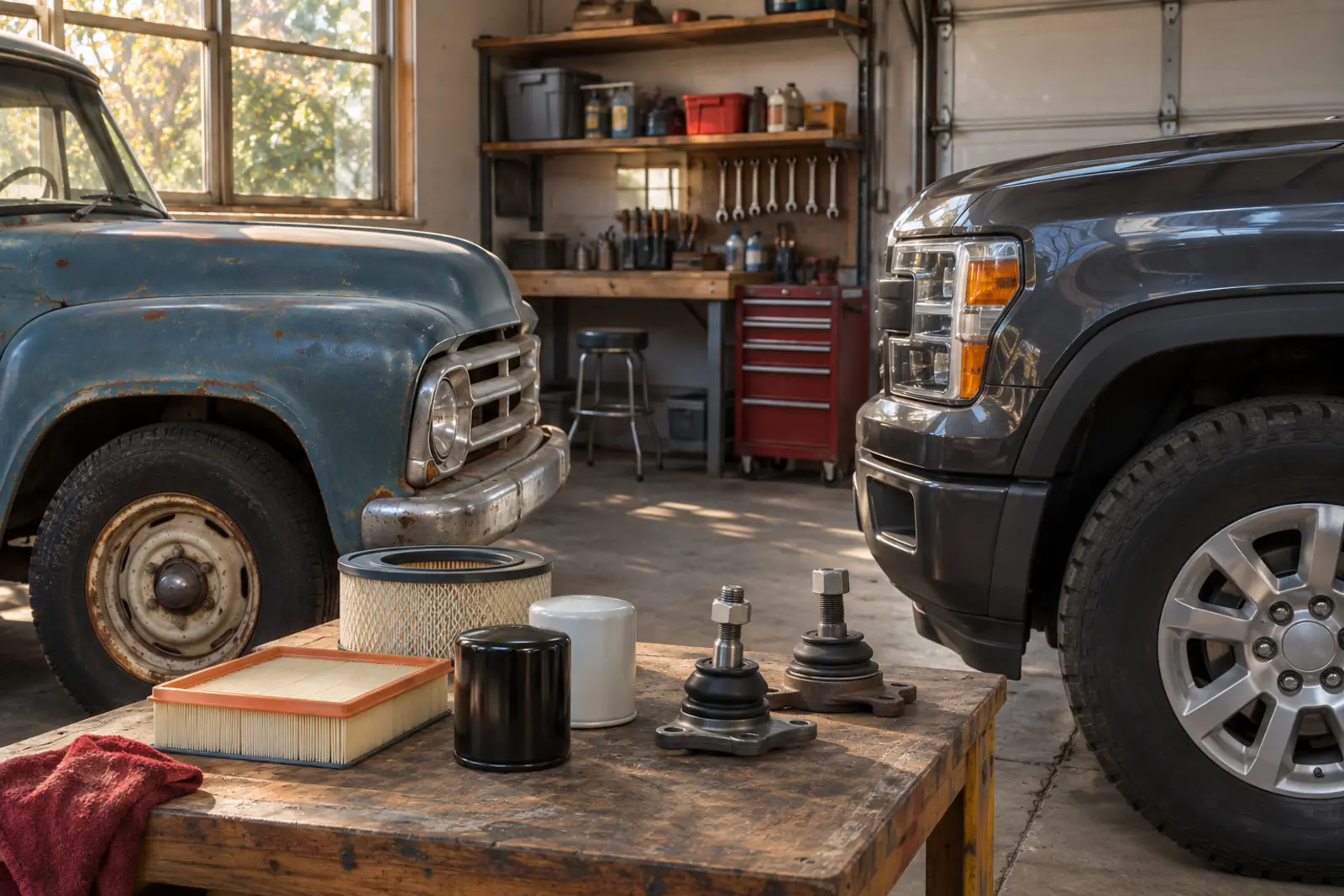
Ford's F-series has been in production since 1948, and the right ford truck parts depend on knowing which generation you own. Body panels, suspension components, and electronics are generation-specific, and the difference between a 2014 and a 2015 F-150 — a switch from steel to aluminum construction — means no body panel crosses that model year divide. This guide maps the key compatibility breaks from the vintage F-100 through current Super Duty models.
Ford F-150 parts by generation
Vintage F-trucks: F-1 and F-100 (1948–1979)
The F-1 (1948–1952) and F-100 (1953–1966) are well-served by specialty restoration suppliers. LMC Truck, Dennis Carpenter Ford Restorations, and Classic Industries all carry grilles, bed floors, weatherstripping, and interior trim no longer available through Ford dealers.
The 1967–1972 fifth-generation trucks are called the Bumpside because of a convex crease that runs along the beltline; both Flareside and Styleside beds were offered on the same platform. The 1973–1979 sixth-generation trucks are called the Dentside because the beltline crease is concave rather than convex. Both generations have strong reproduction support for body panels, grilles, cab corners, and chrome trim.
OBS trucks (1980–1996)
The seventh through ninth generations (1980–1996) are collectively called OBS (Old Body Style). Front shock mounts and many engine components from the 5.0L and 5.8L V8s interchange across much of the 1980–1996 run. The body received a major refresh in 1987, so sheet metal from a 1986 truck does not fit a 1987 without modification. Reproduction steel cab corners, doors, and fenders are available for this era from the same suppliers that handle the vintage trucks.
10th through 12th generation (1997–2014)
The 1997 redesign introduced a fully boxed frame and three cab configurations — Regular Cab, SuperCab, and SuperCrew. Doors are specific to each cab style and do not swap across cab types. Within the 12th generation (2009–2014), a mid-cycle exterior refresh in 2013 updated the front end styling. For bumper selection across this generation, the aftermarket bumper guide covers fitment details by model year.
13th generation (2015–2020): the aluminum platform
Ford's switch to a military-grade aluminum alloy body in 2015 shed 500 to 700 pounds versus the outgoing steel truck. Because aluminum does not rust, bed rot common on older trucks is not a concern. Aftermarket support for the 2015–2020 generation is among the deepest of any truck on the market, covering front coilovers, upper control arms, and off-road bumpers. For suspension height adjustments, the lift kit guide covers coilover and block options for this generation.
14th generation (2021–present)
The current generation continues the aluminum platform. Most exterior parts are compatible across all 2021-and-newer model years. The optional hybrid system and the F-150 Lightning electric variant use unique underhood components that do not interchange with EcoBoost or V8 counterparts.
Ford Super Duty parts by generation
The Super Duty platform — covering F-250, F-350, and F-450 — launched as a dedicated heavy-duty line for the 1999 model year. The F-250 and F-350 share the same cab, frame, and most body panels within each generation, so the same replacement bumper or fender typically fits both. The F-450 shares the cab but uses a heavier frame, axles, and brakes. According to a fitment guide at bumperstock.com, parts break hard at three redesigns: the 2010-to-2011 transition (new front clip and reinforced frame), the 2016-to-2017 transition (aluminum alloy cab and bed construction), and the 2022-to-2023 transition. Within each generation, all model years share mounting points:
- 1st gen pre-facelift: 1999–2004
- 1st gen facelift: 2005–2007
- 2nd gen: 2008–2010
- 3rd gen: 2011–2016
- 4th gen (aluminum body): 2017–2022
- 5th gen: 2023–present
For diesel engine service and upgrades — including Power Stroke injectors, FICM modules, and turbo options by generation — see the diesel performance section.
Ford F-150 Raptor parts
The Raptor is built on the standard F-150 platform but uses unique front suspension geometry, flared bedsides, and a wider bumper that do not interchange with non-Raptor trucks of the same model year. Three generations cover the production run:
- Gen 1 (2010–2014): standard 5.4L V8 (320 hp), optional 6.2L Boss V8 (411 hp); Fox Racing shocks with external reservoirs; SuperCab and SuperCrew configurations
- Gen 2 (2017–2020): 3.5L EcoBoost V6 (450 hp); aluminum construction cut over 500 lbs versus Gen 1; 10-speed automatic
- Gen 3 (2021–present): 3.5L EcoBoost base; Raptor R adds a 5.2L Carnivore supercharged V8 (700 hp, raised to 720 hp for 2024); rear suspension changed from leaf springs to a five-link coil setup
Gen 2 and Gen 3 Raptor parts do not interchange. For EcoBoost and V8 tuning options across the Raptor lineup, the performance tuner guide covers handheld and inline programmer options.
Beds, interior, and body parts
Truck beds rust from the inside out on steel-bodied trucks, and replacement short and long beds are among the most searched Ford parts. When sourcing a bed, match the bed length, wheel arch style, and tailgate design to the cab configuration and model year range. Protecting the bed with a liner is the highest-return first accessory for work trucks — the truck bed liner guide covers spray-in and drop-in options for aluminum and steel beds. Running boards and power deployable steps are frequent additions in this category as well.
Dashboards on 1999–2006 Super Duty trucks are known for cracking, and center consoles wear out on high-mileage work trucks. Replacement dash panels, consoles, and seat components are available as OEM take-offs and aftermarket reproductions. Steel cowl induction hoods are a popular exterior upgrade for both looks and underhood airflow on multiple Super Duty generations.
Frequently Asked Questions
What years of F-150 parts are interchangeable?
Parts interchange most reliably within the same generation. The main compatibility groups are 1980–1986, 1987–1991, 1992–1996, 1997–2003, 2004–2008, 2009–2014, 2015–2020, and 2021–present. The 2014-to-2015 break is the hardest line in F-150 history: steel body parts from 2014 and earlier do not fit the 2015-and-newer aluminum platform, and aluminum repair requires different techniques than steel.
Do F-250 and F-350 share the same parts?
In most cases yes. Both use the same cab, frame, and body panels within each Super Duty generation. Differences appear in axles, brakes, and springs, which are rated higher for the F-350's greater payload. The F-450 shares the cab but uses a different frame and heavier rear axle and brakes.
What changed in the 2017 Super Duty redesign?
The 2017 Super Duty was the first complete redesign since the platform launched in 1999. It introduced an aluminum alloy cab and bed and a frame built from 95% high-strength steel. No exterior body panel from a 2016 Super Duty fits a 2017.
Can standard F-150 parts fit a Raptor?
Not for Raptor-specific components. The Raptor uses wider bedsides, flared fenders, and a unique front bumper and suspension. Engine, interior, and electrical parts that the Raptor shares with the standard F-150 of the same generation usually interchange, but confirm by VIN or part number before ordering.
Where can I find parts for a classic F-100 or Bumpside truck?
Three specialty suppliers cover the vintage era: LMC Truck, Dennis Carpenter Ford Restorations, and Classic Industries. All three stock reproduction grilles, bed floors, interior trim, and weatherstripping that is no longer available through Ford dealers.
Start with your VIN and model year, then check the buying guides for category-specific advice on suspension, lighting, towing, and bed accessories.