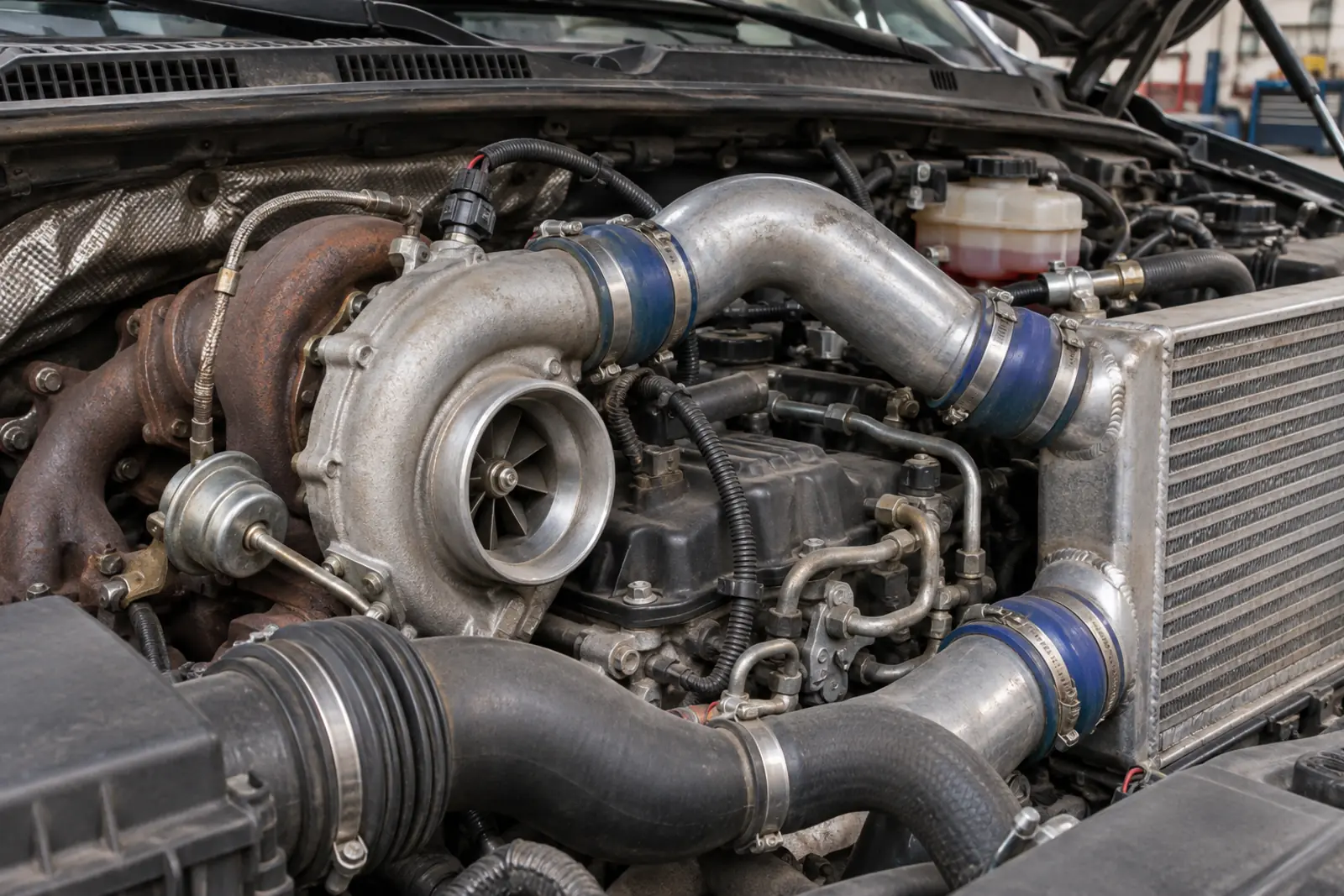
Diesel performance parts: Power Stroke, Duramax, and Cummins
Diesel performance parts for Ford Power Stroke, GM Duramax, and Ram Cummins pickups share the same core logic: more air into the engine, more fuel matched to it, and the supporting hardware that keeps everything from failing under the added load. The categories below cover the main upgrades diesel truck owners add, in a rough order of impact and logical dependency.
Check the baseline first
Before adding any performance parts, verify the truck is mechanically sound. A weak injector, a boost leak, sticking variable-geometry turbo vanes, a restricted oil cooler, or a failing high-pressure fuel pump can produce the same symptoms a performance part is meant to cure. Diagnosing and fixing those faults first prevents wasted spending and can prevent turning a manageable repair into an expensive failure after adding a tune or a larger turbo.
Cold air intake
A cold air intake is one of the most accessible first modifications on a diesel truck. Replacing the factory airbox with a larger-diameter intake tube and a reusable filter reduces restriction before the turbo and lowers intake air temperature. On turbocharged diesel applications, denser intake air improves turbo spool and lowers exhaust gas temperatures (EGTs) under load. Quality bolt-on kits, such as those from S&B Filters, can increase airflow by 20–50 percent over the stock airbox. For a comparison of intake systems across F-150, Silverado, and Ram, see the cold air intake buying guide for pickup trucks.
Intercooler
The intercooler cools the compressed air charge coming from the turbo before it reaches the intake manifold. A larger-core upgraded unit maintains lower intake air temperatures throughout a full pull under load — particularly important during towing, where a heat-soaked stock intercooler allows intake temperatures to rise and EGTs to follow. Direct-fit intercooler upgrades from Mishimoto and Banks Power bolt into the factory location on the 6.7 Power Stroke and 6.7 Cummins with no cutting required.
Exhaust systems
A cat-back or downpipe-back exhaust lowers backpressure, which allows the turbo to spool more freely and can reduce EGTs at the same time. Combined with a tune and cold air intake, a performance exhaust rounds out the basic air-management stack. See the aftermarket exhaust buying guide for pickup trucks for sizing and configuration comparisons across all three platforms.
Lift pumps and fuel supply
A lift pump moves fuel from the tank to the injection pump at low pressure, keeping the supply steady, air-free, and filtered. Duramax-powered trucks have never come with a factory lift pump; aftermarket units from FASS and AirDog extend the life of the CP3 injection pump on 2001–2010 models and are particularly important on the CP4.2 found in 2011–2016 LML trucks, which is susceptible to fuel aeration and ingestion-related failure. On any platform, a lift pump adds water separation and reduces contamination reaching the high-pressure injection side. For 2011–2016 LML trucks requiring major fuel system repairs, a full CP4-to-CP3 conversion — typically around $3,500 in parts and labor — is a common choice; for more on Duramax-specific fuel system work, see the Chevy and GMC truck parts guide.
Turbochargers
Turbo upgrades are among the most popular diesel modifications. Drop-in performance turbos add significant power on most platforms without requiring custom fabrication. When choosing a frame size, match the turbo to your fueling and intended use: an oversized turbo on a stock fuel system produces lag, not power. The 6.7L Power Stroke's early GT32 SST turbo (2011–2014) has a known reliability issue; retrofit kits installing a GT37-style unit are a common corrective step, according to BD Diesel's turbo upgrade guide. The 6.7L Cummins accepts drop-in Screamer HE351 upgrades on 2007.5–2012 trucks and HE300VG units on 2013–2018 trucks. All Duramax models from the LLY (2004.5) forward benefit from performance VGT upgrades when pushing past stock power levels.
Injectors and fuel systems
Injectors are a wear item on every diesel platform. Early Duramax LB7 injectors are a well-known service point, and high-mileage Power Stroke and Cummins engines eventually need injector work too. Remanufactured and new injectors both have their place; what matters most is flow matching across the full set and proper installation with new seals. Stage 2 performance injectors flow roughly 30 percent more than stock units and are typically needed for builds exceeding 500 hp.
Control modules: FICM, TCM, and ECM
Modern diesels depend on their electronics. The fuel injection control module (FICM) on the 6.0 Power Stroke runs a separate 48-volt circuit; low battery voltage from weak batteries or a failing alternator is a known contributing factor in FICM failure alongside heat and vibration, and shows up as hard starts, rough idling, misfires, and inconsistent performance. Transmission control modules and engine control modules fail with age and heat on all platforms. A failing module often mimics mechanical problems, so diagnose before buying parts.
Programmers and tuning
A tuner delivers the highest horsepower-per-dollar return of any single diesel modification. A tune alone typically adds 50–150 hp depending on platform, tune level, and supporting modifications. Modern programmers also enable EGT monitoring that automatically defuels when exhaust temperatures exceed a set threshold — a critical safety function on any tuned truck. Pair any tune with supporting hardware: at higher power levels, the transmission becomes the first limiting factor. For a full comparison of programmers across all three platforms, see the performance tuner buying guide.
Transmission
When engine torque goes up, the transmission becomes the first thing to break. Stock automatic transmissions on tuned diesel trucks can handle mild gains, but builds above roughly 400 hp typically need a rebuilt unit with upgraded clutch packs, a billet input shaft, and a performance valve body. For towing-focused trucks, adding a torque converter upgrade and an improved transmission cooler are sensible steps before pushing power much beyond stock.
Suspension and drivetrain
Leveling kits, upgraded shocks, and larger tires complete most diesel builds. See the leveling kit buying guide for stages and trade-offs.
Frequently Asked Questions
What diesel performance upgrades should I do first?
Start with a tune, then add a cold air intake and exhaust. That combination sets a solid foundation for more hardware later. Before any of that, confirm the truck is running clean: check for boost leaks, verify fuel pressure, and service the air and fuel filters. The most common wasted diesel upgrade money is spent in the wrong order, not on the wrong part.
How much horsepower can a tune add to a diesel truck?
A tune alone typically adds 50–150 hp depending on platform, tune level, and supporting modifications. The highest gains come on engines with clean baselines and proper supporting hardware already in place. Adding a cold air intake and a performance exhaust on top of a tune rounds out the basic air-management stack and allows the calibration to take fuller advantage of the extra airflow.
Will a diesel tuner void my warranty?
Under the federal Magnuson-Moss Warranty Act, a manufacturer must prove the modification caused a specific failure before denying a claim. However, adding a tune does give the manufacturer grounds to dispute powertrain claims on affected components.
What is an EGT gauge and do I need one on a tuned diesel?
An EGT (exhaust gas temperature) gauge measures temperatures in the exhaust manifold, typically before the turbocharger, where readings reflect actual combustion conditions. High EGTs damage turbocharger components, exhaust manifolds, and emissions hardware. Any tuned diesel truck benefits from EGT monitoring; many modern programmers include the function built in and can automatically defuel if temperatures climb above a safe threshold.
Why do Duramax trucks need a lift pump when Power Stroke and Cummins trucks may not?
Ford and Chrysler have equipped their diesel trucks with factory lift pumps at various points; GM has not. Without a supply-side pump moving filtered fuel to the CP3 or CP4.2 injection pump, the high-pressure pump draws directly from the tank and is more vulnerable to aeration and contamination. On 2011–2016 LML Duramax trucks with the CP4.2, the absence of a lift pump is a known contributing factor to injection pump failures, making an aftermarket unit a standard preventive recommendation.